visualizingmath:
Mathematical Spirals
A spiral is a curve which emanates from a central point, getting progressively farther away as it revolves around the point (similar to helices [plural for helix!] which are three-dimensional). Pictured above are some of the most important spirals of mathematics.
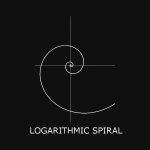
Logarithmic Spiral: Equation: r=ae^bθ. Logarithmic spirals are self-similar, basically meaning that the spiral maintains the same shape even as it grows. There are many examples of approximate logarithmic spirals in nature: the spiral arms of galaxies, the shape of nautilus shells, the approach of an insect to a light source, and more. Additionally, the awesome Mandelbrot set features some logarithmic spirals.
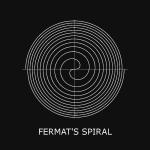
Fermat’s Spiral: Equation: r= ±θ^(½). This is a type of Archimedean spiral and is also known as the parabolic spiral. Fermat’s spiral plays a role in disk phyllotaxis (the arrangement of leaves in a plant system).
Archimedean Spiral: Equation: r=a+bθ. The Archimedean spiral has the property that the distance between each successive turning of the spiral remains constant. This kind of spiral can have two arms (like in the Fermat’s spiral image), but pictured above is the one-armed version.
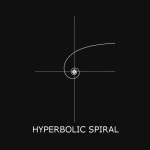
Hyperbolic Spiral: Equation: r=a/θ. It is also know as the reciprocal spiral and is the opposite of an Archimedian spiral. It begins at an infinite distance from the pole in the center (for θ starting from zero r = a/θ starts from infinity), and it winds faster and faster around as it approaches the pole; the distance from any point to the pole, following the curve, is infinite.



















 A Middleground


