Until 1890, the minority party in the U.S. House of Representatives could block a vote by “disappearing.” A minority party member would demand a roll call, all the minority party members would remain silent when their name was called, and then the minority party would declare that too few members were “present” for the House to conduct its business. To incoming Speaker of the House Thomas Brackett Reed, who was the head of the majority party, this was a “tyranny of the minority.“ Within the first month of his term, on January 28th, he resolved to break it. When Democrats demanded a roll call and refused to answer to their names, Reed marked them present anyway. When Kentucky representative James B. McCreary objected, Reed said sweetly, “The Chair is making a statement of fact that the gentleman from Kentucky is present. Does he deny it?”
There followed a sort of ontological shooting gallery. Democrats hid under their desks and behind screens to avoid being observed to exist. When they tried to flee the chamber entirely, Reed ordered the doors locked, which started a scramble to get out before the next vote. Representative Kilgore of Texas had to kick open a locked door to escape. Amid the howled objections, Confederate general “Fighting Joe” Wheeler came down from the rear “leaping from desk to desk as an ibex leaps from crag to crag,” and one unnamed Texas Democrat “sat in his seat significantly whetting a bowie knife on his boot.” Finally the Republicans mustered a majority even with the Democrats entirely absent, and the battle was over: Reed’s new rules were adopted on February 14.
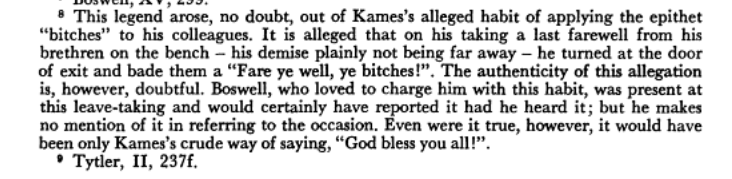
taking scottish legal history was all worth it for this one paragraph about an 18th century judge who liked to call everyone bitches, even when he was dying. added bonus, his famous habit also shows up in a poem with the lines: “’Alemore the judgment as illegal blames,
“Tis equity, you bitch,” replies my Lord Kames”
what she says: i’m fine
what she means: it’s 2 am and I can’t stop thinking about the Pied Piper. Initially i thought it was just an old faerie tale but i’ve been reading up on it and it turns out that at some point in the town of Hamelin, a bunch of children really did go missing all at once in fact a stained glass window in the local church in 1300 was made to tell the story AND Hamelin’s written history literally BEGINS in 1384 with the sentence “it is 100 years since our children left.” There are a ton of theories about what the piper could actually represent but historians are pretty much convinced that something did take away children en masse in the 1200s in Hamelin and to this day we still use the phrase “it’s time to pay the piper.” When will we pay him? Who was he???? Like okay I see the theories but what if some flute paying faerie really just led a bunch of kids away in 1284 I cannot get over this.
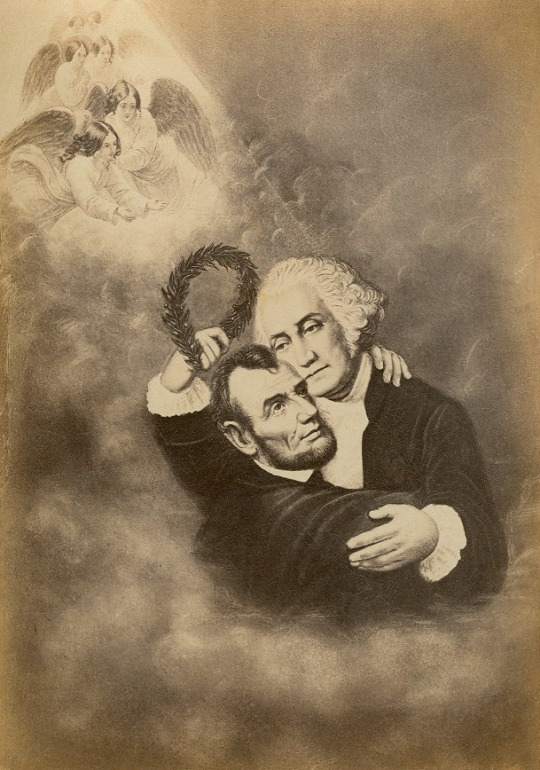
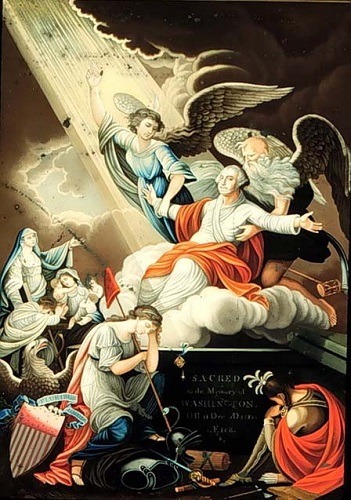
the image “george washington welcomes abraham lincoln into heaven” is so homosexual
everyones reblogging this as if its contemporary or asking who did it but i gotta inform you all it was made in the very same year lincoln was assassinated (1865) and we literally have NO GODDAMNED CLUE who made it and its like fuckin 150 years old
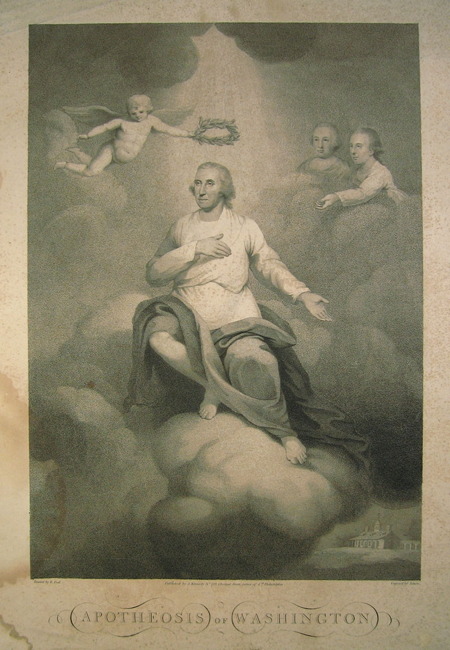
no but here’s where the story gets wild, because this was a thing. and I don’t just mean super gay-looking quasi-religious ascensions of Lincoln into Washington’s arms, we’re talking waaaay weirder than that. I don’t know why it’s not covered in American history classes, because it’s amazing, but Washington enthroned in heaven was such a common motif in American art (largely immediately after his death and again after Lincoln’s assassination) that it has a name: the Apotheosis of Washington. said motif is, simultaneously, incredibly American, incredibly French, incredibly lame, and actually kind of moving in terms of early national mythmaking.
the imagery is largely lifted from paintings of the assumption of the Holy Virgin (as seen here, courtesy of Titian), and usually has Washington ascended into heaven, surrounded by embodied virtues, cherubs, or best of all, old army buddies
(both of whom I briefly mistook for Marie Antoinette)
or here’s a good one, Washington being lifted from his crypt by Father Time and an angel, wearing the expression of a man doing the world’s most unenthusiastic trust fall. note Lady Liberty weeping at his feet, and the Native American warrior playing the part of the grieving land itself. there’s a strong Napoleon vibe in this one, which probably isn’t an accident. that was a man who knew a little something about artistic self-deification.
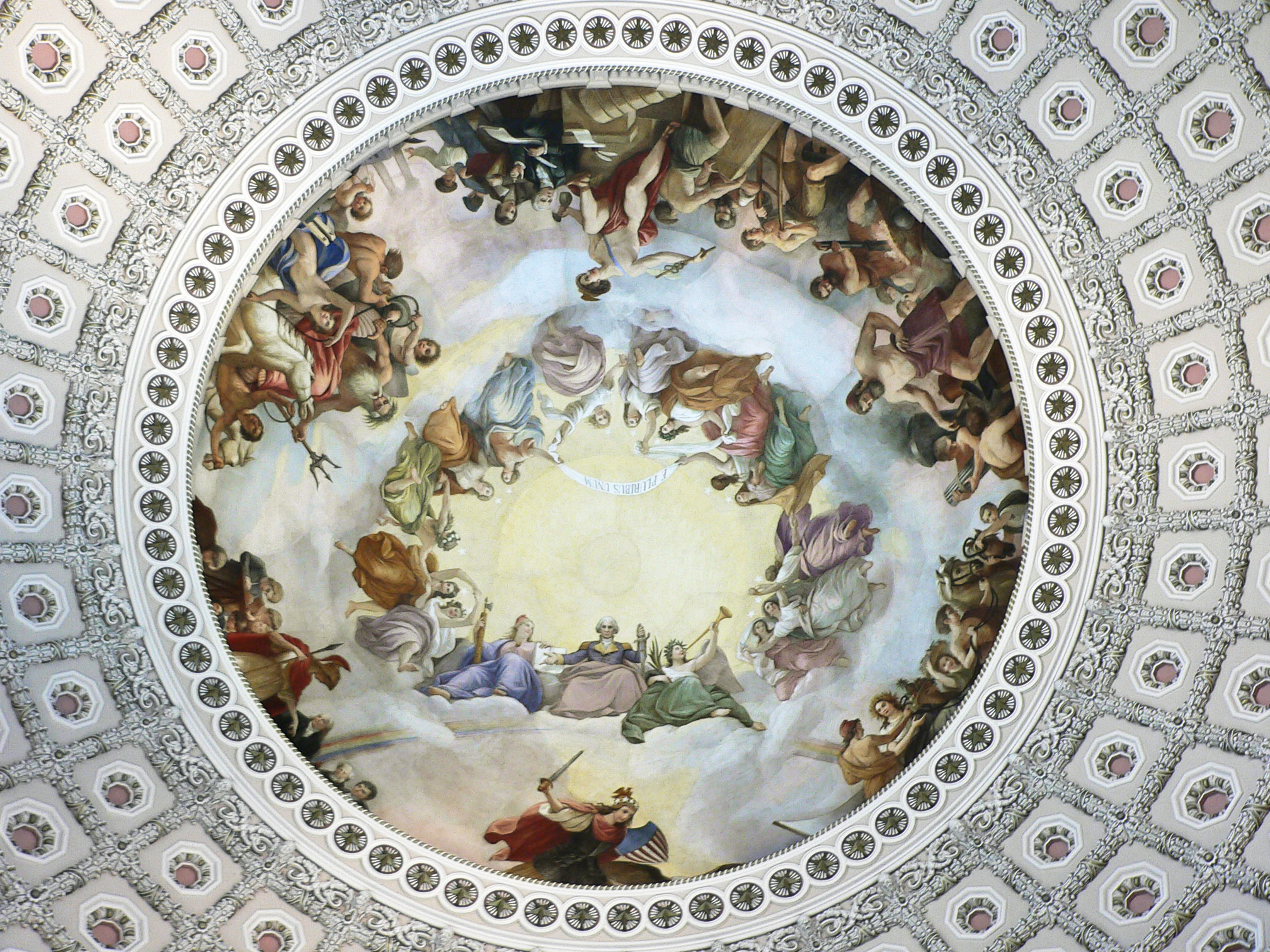
but the prime example of this motif is in the United States Capitol, in a fresco of the same name, (too detailed to blow up here) where Washington sits enthroned, outfitted in military finery and flanked by Liberty and Victory. around him are six scenes displaying American virtues, or rather–with all due disrespect to Neil Gaiman–American gods: Freedom (depicted, tellingly, as War), Science, the riches and firepower of the Sea, Commerce, Mechanics, and Agriculture. Washington presides over all of them, as the man who created a nation with the strength of his will and the fire in his heart. the heavens are spread around him, and he gazes down at the American experiment sternly and benevolently.
…in other words, monarchy is a really hard habit to kick, especially in art. but the Apotheosis of Washington comes at a real crossroads in the developing American psyche. yeah, there’s a lingering hunger for kingship, that old tendency to bend at the knees, ringed around–visually overpowered–by what would rise to fill that void: commerce, invention, war, and the uniquely American conception of Liberty.
the Lincoln thing is water from the same source: Washington forged the country, Lincoln preserved it, and paid the greatest price for his efforts. in fact, the Capitol painting was commissioned the same year Lincoln was shot, for obvious reasons. the almost-but-not-quite-kissing image of both men in the original post was actually a postcard, and was distributed in large quantities in the months following Lincoln’s death. I like to imagine that people had them pinned up in their houses, where they could unconsciously admit another president into the pantheon of gods
but please never be sorry i found your old art history movements LJ post years ago, got a museum studies degree (best known by my family as “don’t ask what her art history classes are like, she’s going to tell you she’s studying butts in England this week.”) and am now in grad school for art history and frankly weird facts about art like this is my literal favorite
please enjoy these other hilariously great pseudo god-like Lincoln’s and/or Washington’s that are my favorites:
a personal fave where George Washington literally stands in for God with a halo of sun rays emanating from his face under which angels call up Lincoln to heaven done by Philadelphia’s Max Rosenthal and also apparently people argue about whether or not it was said “Now he [Lincoln] belongs to the ages.” or “Now he belongs to the angels.”
If you study history for a living you get used to being less than certain about many important facts. Take the famous comment attributed to Secretary of War Edwin Stanton as he stood weeping beside Abraham Lincoln’s deathbed on the rainy Saturday morning of April 15, 1865. “Now he belongs to the ages,” Stanton is supposed to have said, soon after his friend stopped breathing.
also this Pemberton print for Washington where a woman in blue weeps over his death in front of a giant obelisk in a completely unsubtle cribbing of the Virgin mourning christ
They grew up with ex slaves and civil war veterans, they saw World War One, the roaring twenties, World War Two, the rise and fall of the Soviet Union, the transition of America from a majority rual to majority city dwelling nation. The civil rights movement. rock n roll, disco, the birth of amplified music and the synthesizer. All that.
First of all, I apologize for this post being a bit late. I was JUST ABOUT to upload it when the internet at my house cut out. This should not have been a surprise, given all the various technical difficulties in the US yesterday…
Anyways… today’s comic deals with one of the more interesting topics in contemporary Shakespeare studies: Original Pronunciation!
O.P. and the amazing ways in which it has been reconstructed, deserve a lot more space than six stick-figure comic panels, but hey, barbarically reducing things of great literary and scholarly merit to their bare bones is kind of my “thing”. At the very least, now you know that when Hamlet tries to rhyme “move” and “love”, it’s not actually him pretending to be mad.
The super-linguist in question is David Crystal, whose praises I repeatedly sung. In his O.P. endeavors he has been ably assisted by his son, Ben Crystal, an actor who, armed with Shakespeare’s O.P., can make the prologue of Romeo and Juliet sound sexier and more piratical than you could have ever imagined. If you don’t believe, just take a listen:
Seriously. That’s gorgeous. Here’s a longer video, featuring Papa Crystal and Ben at the Globe:
It’s easy to get snobbish about Shakespeare and to believe it works only when performed in the elegantly trained received pronunciation of an Ian McKellen or a Benedict Cumberbatch. But, as the Crystals point out, received pronunciation is even further away from Shakespeare’s original accent than American are from it.
Shakespeare can be performed in any accent. English, Welsh, Scottish, American, Canadian, Singaporean, I don’t care. His words still have immense power. However, when you hear it spoken in O.P., you really get a sense of what it must have been like for those first groundlings at the first Globe Theatre.
So, this old post has picked up about 700 new notes in the past couple days, which makes me happy because the world needs (a) more appreciation of OP, and (b) more appreciation of the Magnificent Linguistic Crystals. Here, let me add on a couple more links:
Passion in Practice – Theatre company founded by Ben Crystal, does awesome OP productions. Or at least I assume they’re awesome, but they haven’t come on tour to Michigan yet. What’s up with that, Ben?
Original Pronunciation – Site run by the Crystals, including tons of great resources for people who want to learn OP.
I swear I hadn’t planned this, but this is the perfect post for Talk Like a Pirate Day.
Today in the modern world we take freezers, and the frozen results of freezers for granted. But in ancient times, cold drinks, frozen desserts, and chilled tropical cocktails were a luxury unknown to most people. However the idea of artificially freezing goods is nothing new. As far back as 400 BC, the ancient Persians built special freezers called yakhchals. Yakhchals were large buildings used for storage of ice and foodstuffs during the hot Persian summers. Typically they were around 60 feet tall, and had a large subterranean storage space dug out from under it. The Yakhchal itself was made from a special type of mud clay called sarooj which was composed of clay, sand, lime, goat hair, egg whites, and ash mixed in a special proportion which made it extremely resistant to heat transfer. In other words the inside stayed cool, while heat from the outside was prevented from entering the building because of the thick insulated walls. This combined with the subterranean storage ensured that whatever goods were stored in the pit stayed cool, as temperatures below ground level are usually around the 60 to 65 degree Fahrenheit range. However, these designs were not what made a yakhchal a freezer. There was one other brilliant design feature which ensured that the yakhchal would stay frosty all year long.
At the top of the dome was a small hole, or series of small holes called windcatchers. Typically windcatchers were pointed in the direction of the prevailing winds. Due to its conical shape there was always a negative pressure gradient inside the yakhchal. According to Bernoulli’s Law air flow at a high pressure will always move toward areas of low pressure. Thus air from the outside was constantly flowing through the yakhchal. In addition, according to Venturi’s Principal, whenever air flows through a small hole, the smaller the hole, the greater the speed of the flow. The small hole, or series of holes of the yakhchal ensured that air passed into it at great flows. What resulted was a great amount of outside air entering into the yakhchal at high speeds. While the air itself wasn’t cool, the flows at which it was being entrained into the yakhchal created temperatures that were below freezing. Typically the windcatchers were cut in such a way that the incoming jet of air would be directed onto the storage pit.
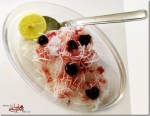
The ancient Persians primarily used their yakhchals for storing ice and foodstuffs. During the summer, Persian nobles often enjoyed a frozen treat called faloodeh (pictured above), which is made from thin noodles with syrup made from sugar and rose water, then flavored with lemon, lime, fruits, almond, pistachio, and other flavorings. Due to the Persian’s freezing technology, faloodeh (which is still popular today) goes down in history as one of the first frozen desserts. The practice of building and using yakhchals continued up to the 20th century, when they were eventually replaced with modern freezers and refrigerators.








 A Middleground