Seriously, I get what you’re going for, but stop using Cleopatra as an example when there are tons of great Egyptian queens who we have actual archeological evidence were black or olive skinned. Because Cleopatra was super Greek.
Ancient Egypt is not a monolith. It was invaded multiple times, by desert dwelling Hittites, by the people of modern Sudan, and once by Alexander the Great.
Alexander put his very Greek general in charge, and eventually this ended up as the Ptolemaic dynasty, a bunch of Greek people intermarrying each other, until we got Cleopatra the Famous. Cleopatra was one of the first people in her dynasty to learn native Egyptian because the rest of them spoke solely Greek. Her father worshipped Dionysus. There’s even some evidence she may have been a red head. She was probably white, albeit Mediterranean white.
Ancient Egypt had dozens of dynasties and tons of rulers. Most of them were not white, why do you guys keep insisting on ignoring all of the great Quuens like Tiye, Ankhsenamun, and Nefertiti to focus on Cleopatra and ignoring historical facts about her?
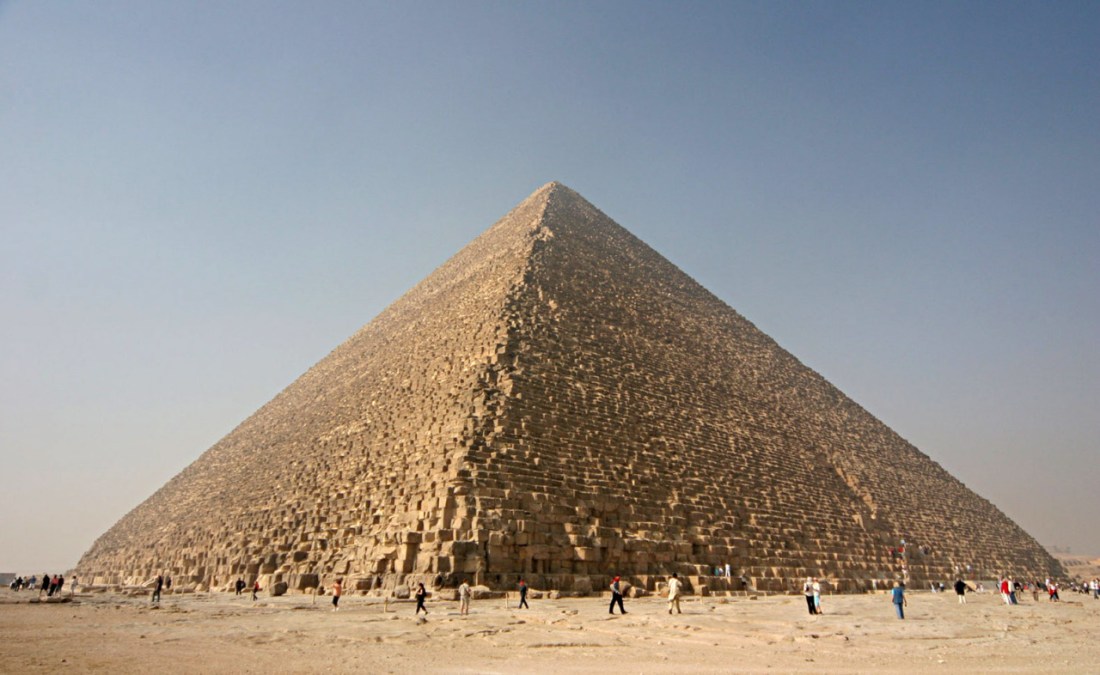
This is the Great Pyramid of King Khufu. Everybody knows the Great Pyramid of King Khufu, but you probably don’t know about the Shit Pyramids of his father, King Sneferu. This is a shame, because they are amazing.
When King Sneferu came to the throne of Egypt, the cool thing that all the pharaohs had was a Step Pyramid, like the original one built by King Djoser and designed by Imhotep (not the mummy). King Sneferu could easily have had one one because his predecessor King Huni had died before his could be finished. All Sneferu had to do was step in and put the last few blocks on.
But King Sneferu had a vision. He didn’t want any old Step Pyramid. He was going to build Egypt’s first smooth-sided pyramid, and make King Huni’s pyramid way taller in the bargain. It didn’t work. The core of Huni’s pyramid couldn’t handle the modifications and nowadays the Step Pyramid at Meidum looks like this:
It’s not on a hill – that’s the outer layers of the pyramid that have fallen down all around it. The name of the structure in Arabic is Heram el-Kaddaab, which means something like The Sort-Of Pyramid.
Anyway, King Sneferu was understandably disappointed and made his pyramid-builders start over from scratch at a different site. Apparently having learned nothing about the Big Fat Nowhere that hubristic pyramid ambition was going to get him, this pyramid was designed to be even taller and pointier than the last effort! Too tall and pointy, in fact – the bedrock proved to be less stable than he might have hoped, and by the time the pyramid was half-finished stuff was already moving and cracking inside of it. There are ceilings in this pyramid that are to this day partially held up by wooden beams.
The builders seem to have panicked and decided that the only way to finish the pyramid without another disaster was to make the top half lighter than the bottom half. They did this by changing the angle of the slope, ending up with a pyramid that looks like this:
Egyptologists call this one the Bent Pyramid for fairly obvious reasons. Uniquely among Egyptian Pyramids, it has most of its smooth outer blocks intact, rather than having them all stolen to build other stuff (most of medieval Cairo is built from the skin of the Giza pyramids). I’m guessing this is because nobody dared touch the thing for fear the whole structure would come down like a giant limestone game of Jenga.
I’m sure the pyramid-builders were very proud of this solution. Sneferu appears to have been less so. He had them move over about half a mile and start over. Again. Why only half a mile when he had them move 34 miles between the Sort-of Pyramid and the Bent Pyramid is a mystery. I think he wanted to keep them in sight of the Bent Pyramid so they could look at it and feel ashamed every once in a while.
And there they built Sneferu’s third pyramid, which is called the Red Pyramid. As pyramids go, it’s a very cautious one – it’s got the shallowest slope rise of any Egyptian pyramid, and while it’s the same height as the Bent Pyramid it spreads its weight over a much greater base area, making it far more stable. Sneferu seems to have been happy with this one, because he was buried in it. Either that, or after a forty-eight-year reign he just finally died and that was the pyramid they used because it was the nicest of the three.
These three pyramids together actually contain substantially more stone than the Great Pyramid of Sneferu’s son Khufu. By the time Sneferu died, his workforce had honed themselves into a lean, mean pyramid-building machine. They had already made every possible pyramid mistake. So when Khufu announced that he didn’t just want a great pyramid, but The Great Pyramid, these guys built him a pyramid so fucking great that we now think aliens must have done it.
It was as true in Ancient Egypt as it is now.
About a month ago, archaeologists found a sealed rock cut tomb in Tarquinia. At the front door before they even opened the tomb, they found jars and vases indicating that this was likely an important person. When they removed the slab, they found a small vaulted chamber with the remains of two individuals on stone platform beds. They believed the first skeleton to be the remains of an Etruscan prince who was holding a spear and had a fibulae at his chest which indicated he had been dressed in a mantle. He was accompanied by the cremated remains of his wife who was jeweled and placed on the second platform, and food remains within a large bronze basin at his feet. A number of grave goods, which included large Greek Corinthian vases and precious ornaments, lay on the floor.
Now the remains have been studied, and archaeologists realize that they made an oops. The bones have shown that the skeletonized individual thought to be male is actually female, and the cremated remains of the ‘wife’ were actually of a male. Their re-interpretation of the site with this evidence now argues that the lance, which was previously determined to be a sign of royalty of the prince, is now thought to be a symbol of union between the two deceased.
So let’s break this down- when the skeleton was male the lance was a sign of royal status, and now that the ‘prince’ is a female the lance is a sign of marriage unity between the two individuals. Isn’t this secondary interpretation just as biased as the first one? Why can’t a female have a lance as a symbol of her power?
Weingarten was among the first to question this new interpretation in her blog. She rightly asks “Why is it so difficult to understand that the ruling class of Etruscan society was made up of both men AND women?” Weingarten discusses the historical evidence for women in Etruscan society, noting that they were equally involved in government and noble society. Stories of the women reveal that they were outspoken and played an important role in determining the status of their husbands. She notes that there is no reason why men can’t be buried with jewelry and females can’t be buried with a spear.
What is happening here is that archaeologists are projecting modern bias into the past, and making assumptions about gender roles in this society. [ … ]
This isn’t a singular event- issues in gender bias and mistaken identity are quite common. The study of gender revealed a major source of bias in archaeology, specifically the unconscious projection of modern perception and bias onto the past. This was first noted in the landmark article by Conkey and Spector (1984), which argued that archaeology has reinforced western European gender stereotypes, including contemporary meanings of masculine and feminine, the capabilities of each, power relationships and the traditional gender roles. Subsequently, numerous archaeologists began to recognize bias in their respective areas, and began taking a gendered approach.
A great example of this re-interpretation with new gendered evidence is within the study of Viking. Stalsberg (2001) interprets grave goods in order to gain insight on what women’s roles were during the Viking Age, approximately the eighth to eleventh centuries AD. The important artifact under consideration is a piece of weighing equipment that consists of small folding balance scales and the associated weights. Stalsberg (2001:73) notes that these ‘men’s tools’ are often found in women’s graves. From the analysis of three cemeteries, she finds that from 17-32 percent of the weighing equipment is associated with female graves. “Based on this, the women had a right to be buried with the weighing equipment… [and] they constitute the tools of women’s economic unit, household or family” (Stalsberg 2001:74). This would mean that females were involved in the trade, and likely that it was a family run business. Another great example is McLeod’s (2011) analysis of burials in which he argued that swords cannot be equated to males, since they do appear in female burials. (You can read my write-up of his writing here: Viking Women- A reinterpretation of the bone)
We need to be careful when interpreting gender and sex. Mistakes do happen, but having two gendered assumptions in a row is a little much. As Stalsberg (2001) argued: if a connection can be made between men and their grave goods as indications of status, then this must too be applied to women.
AIN’T NO PARTY LIKE A BOSTON TEA PARTY BECAUSE A BOSTON TEA PARTY DON’T STOP UNTIL BOSTON IS PUT UNDER MARTIAL LAW AND EVERYONE IS DISILLUSIONED WITH PARLIAMENT AS A WHOLE.
“St. Louis, Mo., Dec 14.– Ruling that male attire was not unbecoming to Mrs. Mary Bertha Schmidt, alias ‘Mister Schmidt,’ judge Hogan, in police court here, refused to fine the young woman who for two years posed as a man and who ‘married’ her cousin, Anna Assade, last October.
‘I think you look very nice,’ said the court. Mrs. Schmidt was clad in her neatly pressed trousers and pinchback coat. She explained she had adopted the garments because she could earn $80 a month as a man and $6 a week as a woman.
‘If a woman can earn $4 a day by reason of wearing trousers, I say wear ‘em,’ said the court, and ‘Mister Schmidt’ walked out of court with a smile on ‘his’ face.”
ok here’s some facts about my guy baron von steuben
very dubious claims of
nobility. i’m too drunk and lazy to look it up right now but i’m pretty
sure he shouldn’t have actually been called a baron
anyway he served in the prussian army under frederick the great but he was discharged because of some big gay sex scandal
he spent a while in germany but – you guessed it – got into another big gay sex scandal
eventually
he realized his best option, to avoid prosecution for all these big gay
sex scandals, was to leave europe entirely and go to america where they
had way bigger fish to fry at the moment
so he’s recruited by
the continental army, with the assistance of a letter of recommendation
from ben franklin that HUGELY exaggerates his experience, probably
unintentionally (the french title “Lieutenant General Quarters Maitre”
was mistranslated as “lieutenant general” even though it really
meant “deputy quartermaster”)
so he rolls into america – first
of all, he’s arrested at the dock because he accidentally dressed
himself and all his men in red coats and everyone thought they were
british soliders. awkward
so once that’s all worked out, he rolls
into valley forge with his whole crew – like, several aides, a chef, his
dog, the whole shebang, and he’s greeted by an army of dudes who don’t
even have matching coats and haven’t showered in 10 years. these guys
are literally using their bayonets as cooking skewers, that’s how
piss-poor an army they are. steub is like “WHAT THE FUCK IS THIS?” he is so disgusted with them
so the steub starts devising a
bunch of drills for them to kick their ass into shape. the problem here
is, he doesn’t speak a word of english, so he generally conducts drills
by cursing at the soldiers in an incomprehensible mix of german, french,
and english, leaving his french-speaking aides (alexander hamilton and
john laurens among them) to translate for him
language barrier aside, everyone absolutely loves him. he’s such a dude. at one point in the war he holds a pantsless party, like, where you’re only allowed into the tent if you’re not wearing pants? flaming shots were served. this really happened i can source it if you want
literally america would not exist without this guy. the army was a fucking DISASTER before he showed up and taught them how to fight
anYywaY after the war he moves in with two of his aides/sugar babies, future senator william north and future state representative benjamin walker. the actual situation among these housemates is unclear but some of them were definitely banging each other. anyway, later in life he legally ADOPTS these two guys because he’s such a dedicated sugar daddy
he takes in a whole harem of hot young twinks including, at one point, john adams’ son and hercules mulligan’s son after the adamses try to break the two lovebirds up
he had no idea how to handle money and poor alexander hamilton had to manage all his finances and save him from bankruptcy lmao
BRITISH EMPIRE: All right, fine, your stupid embargo worked. We won’t levy any more taxes-
AMERICAN COLONIES: Huzzah! Time to get drunk!
BRITISH EMPIRE: Except on tea.
AMERICAN COLONIES: What?
BRITISH EMPIRE: Get over it, it’s just tea. Seriously, where do you get this idea that you’re special and should never have to pay taxes? We hope that idea doesn’t go on to infect your political discourse centuries from now.
AMERICAN COLONIES: We’re not buying your stupid tea.
BRITISH EMPIRE: Are you being serious right now? What are you going to do, just stop drinking tea?
AMERICAN COLONIES: Yes. We’ll drink coffee.
BRITISH EMPIRE: Do you even know what that is?
AMERICAN COLONIES: No, but we’ve heard it’s good and we’re feeling surly.
BRITISH EMPIRE: Fine, whatever, we don’t even care what you do anymore.
BRITISH EAST INDIA COMPANY: Actually, we are pretty much bankrupt, so you need to make them drink the tea.
BRITISH EMPIRE: Oh, for—just drink the tea.
AMERICAN COLONIES: No.
BRITISH EMPIRE: Do it.
AMERICAN COLONIES: NO.
BRITISH EMPIRE: Drink it.
AMERICAN COLONIES: Fuck you.
BRITISH EMPIRE: Drink it or we’ll punch you in the face.
AMERICAN COLONIES: *Boston Tea Party*
BRITISH EMPIRE: What the hell?
AMERICAN COLONIES: We heard it was Indians.
BRITISH EMPIRE: That’s interesting, because we heard it was a bunch of colonists wearing paint and dressed in costumes that were remarkably similar to what a crowd of drunks who wanted to look like Indians would assemble if the only supplies they had were found in an alley behind a bar.
AMERICAN COLONIES: You get all types in Boston.
BRITISH EMPIRE: …*Coercive Acts*
AMERICAN COLONIES: Oh, it is ON.
Do you ever see people whose faces echo another era?
I’ve seen women with the round faces, sparse brows and high foreheads of medieval illuminated manuscripts.
Men with dark brows that meet in the middle, olive skin, strong noses and jaws–Byzantine men, ghosts of Constantine, reanimated faces from the Fayum Mummy Portraits.
Women with soft figures and the large eyes and prim, petaled mouths of the 19th century.
Grizzled men whose brows predicate their gaze, whose wrinkles track into their thick beards and read like topographical maps of hardship and intensity–the wanderer, the poet; Whitman, Tolstoy, Carlyle.
Faces sculpted into the perfect, deified symmetry of the pharaohs–almond eyes, full lips, self-assurance 3,000 years in the making staring at you at a stoplight.
Plump, curved white wrists curled over purse handles in the waiting room and you think Versailles, Madame Pompadour, Marie Antoinette, Catherine the Great. Wide cheek bones, courage and sorrow in the scrunched face of the old man in line behind you and it’s Geronimo, Sitting Bull, Tecumseh. Reddened skin, thick forearms, hair and beard and brows burned by the cold into a reddish corn silk and you think Odin, the forge and the hammer and skin stinging from the salt of the ocean.
Virginia Woolf’s quiet brand of gaunt frankness surveys you in passing in the parking lot. Queen Victoria’s heavy-lidded stare and beaked nose are firmly, uncannily fixed on a sixth-grade classmate’s face.
Renaissance voluptuousness on the boardwalk by the beach. Boticelli’s caramel androgyny in a youth smoking on a bench outside the mall.
Jazz age looseness spurs the tripping gait of the man who watches you paint with his hands in his pockets, and he smiles a Sammy Davis Jr. smile and tells you that you look familiar, that he’s sure he’s seen you somewhere before, but he doesn’t know where or when.
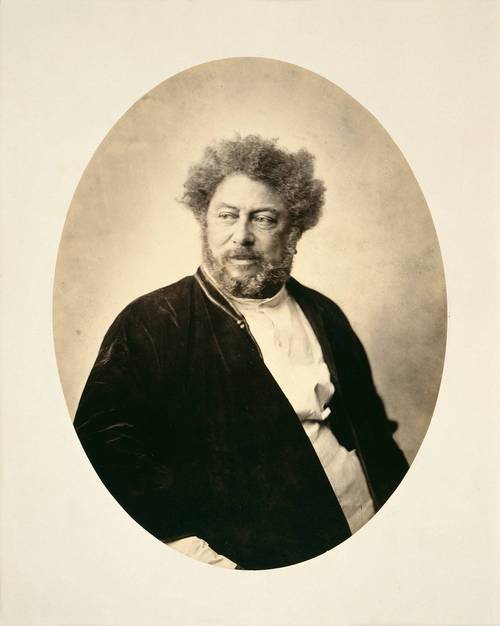
Let’s not forget to acknowledge Alexandre Dumas this Black History Month
The writer of two of the most well known stories worldwide, The Three Musketeers and The Count of Monte Cristo was a black man.
That’s excellence.
Let’s not forget that he was played on screen by a white man. And the fact that he was black is barely ever mentioned or the book he wrote inspired by his experiences.
Other things not to forget about Alexandre Dumas:
chose to take on his slave grandmother’s last name, Dumas, like his father did before him.
grew up too poor for formal education, so was largely self-taught, including becoming a prolific reader, multilingual, well-travelled, and a foodie, resulting in his writing both a combination encyclopedia/cookbook (which just— is fucking outrageous to me) AND the adaptation of The Nutcracker on which Tchaikovsky based his ballet
he also wrote a LOOOOT of nonfiction and fiction about history, politics, and revolution, bc he was pro-monarchy, but a radical cuss, and that got him in a lot of hot water at home and abroad.
even beyond that, he generally put up with a lot of racist bullshit in France, so he went and wrote a novel about colonialism and a BLATANTLY self-insert anti-slavery vigilante hero (which he then cribbed from to write the Count of Monte Cristo, the main character of which, Edmond Dantés, Dumas also based on himself).
(…a novel which also features a LOAD of PoC beyond the Count, and at LEAST one queer character, btw, bc EVERY MOVIE ADAPTATION OF ANYTHING BY DUMAS IS A LIE; seriously, at LEAST one of the four Musketeers is Black, y’all.)
famously, when some fuckshit or other wanted to come at Dumas with some anti-Black foolishness, Dumas replied, “My father was a mulatto, my grandfather was a Negro, and my great-grandfather a monkey. You see, Sir, my family starts where yours ends.”
for the bicentennial of his birthday, Pres. Jacques Cirac was like, “…sorry about the hella racism,” and had Dumas’s ashes reinterred at the Panthéon of Paris, bc if you’re gonna keep the corpses of the cream of the crop all together, Dumas’s more widely read and translated than literally everybody else.
and they are still finding stuff old dude wrote, seriously; like discovering “lost” works as recently as 2002, publishing stuff for the first time as recently as 2005.
ALSO IMPORTANT:
SWAG
I am absolutely ashamed to admit I had NO idea Dumas was black.
daddy general dumas was an immense fierce french warrior who was a 6 foot plus, stunningly gorgeous and charismatic Black gentleman
he invaded egypt
the native egyptians said “is this napoleon? this must be napoleon. we for one welcome our majestic new overlord”
then napoleon showed up
napoleon has all the presence of yesterday’s plain Tesco hummus
the native egyptians were like “… no… no, we’ve thought very hard and we’ll have General Dumas actually”
this did not make napoleon happy
in fact it made him jealous
napoleon felt so emasculated that he launched a campaign of revenge against General Dumas, including taking away his pension, that probably inspired a lot of Alexandre’s rather satisfying scenes in which fathers are nobly avenged and the money-grubbing villains are rubbed in the mud
I was never taught that he was Black either. WTF.
I knew Dumas was black, but I’ve never seen these pictures before. A lot of this didn’t click with me until just now.
“Martha Washington often recalled the two saddest days of her life. The first was December 14, 1799 when her husband died. The second was in January 1801 when Thomas Jefferson visited Mount Vernon. As a close friend explained, “She assured a party of gentlemen, of which I was one…that next to the loss of her husband” Jefferson’s visit was the “most painful occurrence of her life.”
please note that george washington was martha washington’s second husband, so her rank potentially went 1) george dying, 2) jefferson in her house, 3) first husband dying.




 A Middleground