
Theories about the Origins of Space and Time.
1. Gravity as Thermodynamics
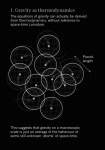
Entropic gravity is a theory in modern physics that describes gravity as an entropic force – not a fundamental interaction mediated by a quantum field theory and a gauge particle, but a consequence of physical systems’ tendency to increase their entropy.2. Loop Quantum Gravity
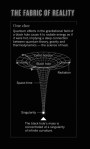
According to Einstein, gravity is not a force – it is a property of space-time itself. Loop quantum gravity is an attempt to develop a quantum theory of gravity based directly on Einstein’s geometrical formulation. The main output of the theory is a physical picture of space where space is granular. More precisely, space can be viewed as an extremely fine fabric or network “woven” of finite loops. These networks of loops are called spin networks. The evolution of a spin network over time is called a spin foam. The predicted size of this structure is the Planck length, which is approximately 10−35 meters. According to the theory, there is no meaning to distance at scales smaller than the Planck scale. Therefore, LQG predicts that not just matter, but space itself, has an atomic structure.3. Causal Sets
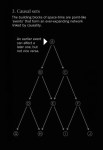
Its founding principles are that spacetime is fundamentally discrete and that spacetime events are related by a partial order. The theory postulates that the building blocks of space-time are simple mathematical points that are connected by links, with each link pointing from past to future. Such a link is a bare-bones representation of causality, meaning that an earlier point can affect a later one, but not vice versa. The resulting network is like a growing tree that gradually builds up into space-time.4. Causal Dynamical Triangulations
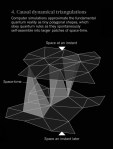
The idea is to approximate the unknown fundamental constituents with tiny chunks of ordinary space-time caught up in a roiling sea of quantum fluctuations, and to follow how these chunks spontaneously glue themselves together into larger structures. The space-time building blocks were simple hyper-pyramids (four-dimensional counterparts to three-dimensional tetrahedrons) and the simulation’s gluing rules allowed them to combine freely. The result was a series of bizarre ‘universes’ that had far too many dimensions (or too few), and that folded back on themselves or broke into pieces.5. Holography
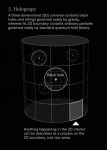
In this model, the three-dimensional interior of the universe contains strings and black holes governed only by gravity, whereas its two-dimensional boundary contains elementary particles and fields that obey ordinary quantum laws without gravity. Hypothetical residents of the three-dimensional space would never see this boundary, because it would be infinitely far away. But that does not affect the mathematics: anything happening in the three-dimensional universe can be described equally well by equations in the two-dimensional boundary, and vice versa.just fyi the source is nature.com so it’s very reliable and scientifically accurate; nature is one of the most widely published scientific journals.






















 A Middleground