An Iraqi/German pair of artists
just pulled off what might be one of the most digitally-enhanced art
heists in recent time. They covertly scanned the Nefertiti bust (with an Xbox 360 Kinect sensor, no less) and released the 3D printing plans online. They did so as an act of defiance, as the bust was actually looted from an Egyptian site by German archaeologists.[x]
Last October, two artists entered the Neues Museum in Berlin, where they
clandestinely scanned the bust of Queen Nefertiti, the state museum’s
prized gem. Three months later, they released the collected 3D dataset
online as a torrent, providing completely free access under public
domain to the one object in the museum’s collection off-limits to
photographers. Anyone may download
and remix the information now; the artists themselves used it to create
a 3D-printed, one-to-one polymer resin model they claim is the most
precise replica of the bust ever made, with just micrometer variations.
That bust now resides permanently in the American University of Cairo as
a stand-in for the original, 3,300-year-old work that was removed from
its country of origin shortly after its discovery in 1912 by German
archaeologists in Amarna.
Nora Al-Badri and Jan Nikolai Nelles with the 3D bust in Cairo
The project, called “The Other Nefertiti,” is the work of German-Iraqi artist Nora Al-Badri and German artist Jan Nikolai Nelles,
who consider their actions an artistic intervention to make cultural
objects publicly available to all. For years, Germany and Egypt have
hotly disputed
the rightful location of the stucco-coated, limestone Queen, with
Egyptian officials claiming that she left the country illegally and demanding
the Neues Museum return her. With this controversy of ownership in
mind, Al-Badri and Nelles also want, more broadly, for museums to
reassess their collections with a critical eye and consider how they
present the narratives of objects from other cultures they own as a
result of colonial histories.
The Neues Museum, which the artists believe knows about their project
but has chosen not to respond, is particularly guarded towards
accessibility to data concerning its collections. According to the pair,
although the museum has scanned Nefertiti’s bust, it will not make the
information public — a choice that increasingly seems backwards as more
and more museums around the world are encouraging the public to access
their collections, often through digitization projects. Notably, the
British Museum has hosted
a “scanathon” where visitors scanned objects on display with their
smartphones to crowdsource the creation of a digital archive — an event
that contrasts starkly with Al-Badri and Nelles’s covert deed.
3D rendering of the bust of Nefertiti
“We appeal to [the Neues Museum] and those in charge behind it to
rethink their attitude,” Al-Badri told Hyperallergic. “It is very simple
to achieve a great outreach by opening their archives to the public
domain, where cultural heritage is really accessible for everybody and
can’t be possessed.”
In a gesture of clear defiance to institutional order, Al-Badri and Nelles leaked
the information at Europe’s largest hacker conference, the annual Chaos
Communication Congress. Within 24 hours, at least 1,000 people had
already downloaded the torrent from the original seed, and many of them
became seeders as well. Since then, the pair has also received requests
from Egyptian universities asking to use the information for academic
purposes and even businesses wondering if they may use it to create
souvenirs. Nefertiti’s bust is one of the most copied works from Ancient
Egypt — aside from those with illicit intents, others have used photogrammetry
to reconstruct it — and its allure and high-profile presence make it a
particularly charged work to engage with in discussions of ownership and
institutional representations of artifacts.
“The head of Nefertiti represents all
the other millions of stolen and looted artifacts all over the world
currently happening, for example, in Syria, Iraq, and in Egypt,”
Al-Badri said. “Archaeological artifacts as a cultural memory originate
for the most part from the Global South; however, a vast number of
important objects can be found in Western museums and private
collections. We should face the fact that the colonial structures
continue to exist today and still produce their inherent symbolic
struggles.”
Al-Badri and Nelles take issue, for instance, with the Neues Museum’s
method of displaying the bust, which apparently does not provide
viewers with any context of how it arrived at the museum — thus
transforming it and creating a new history tantamount to fiction, they
believe. Over the years, the bust has become a symbol of German identity,
a status cemented by the fact that the museum is state-run, and many
Egyptians have long condemned this shaping of identity with an object
from their cultural heritage.
Ultimately, the artists hope their actions will place pressure on not
only the Neues Museum but on all museums to repatriate objects to the
communities and nations from which they came.
Rather than viewing such
an idea as radical, they see it as pragmatic, as a logical update to
cultural institutions in the digital era: especially given the
technological possibilities of today, the pair believes museums who
repatriate artifacts could then show copies or digital representatives
of them. Many people have already createdtheirown Nefertitis from
the released data; the 3D statue in the American University in Cairo
stands as such an example of Al-Badri and Nelles’s ideals for the future
of museums, in addition to being one immediate solution that may arise
from individual action.
“Luckily there are ways where we
don’t even need any topdown effort from institutions or museums,”
Al-Badri said, “but where the people can reclaim the museums as their
public space through alternative virtual realities, fiction, or
captivating the objects like we did.”
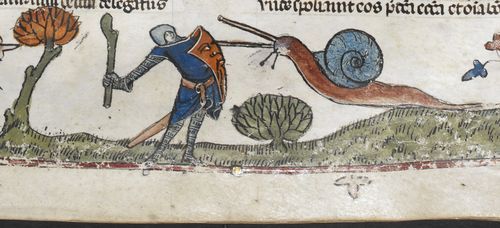
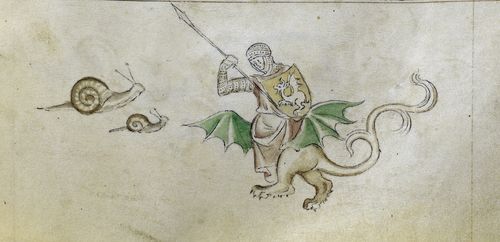
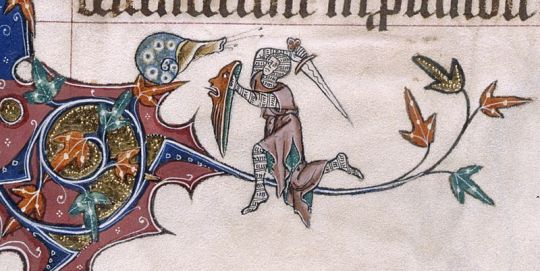
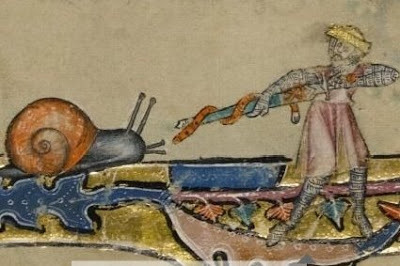
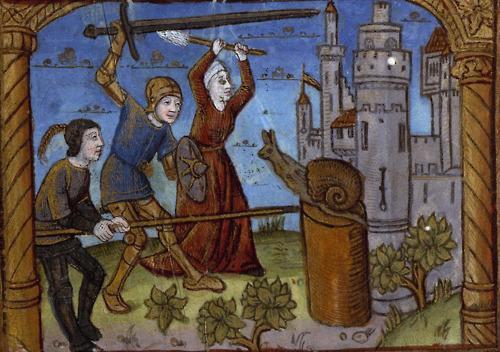
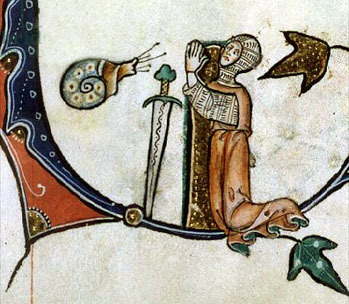
apparently modern medieval scholars have no solid idea why there’s so many old paintings of knights fighting snails. Like that wasn’t just one weird painting there’s hundreds of those.
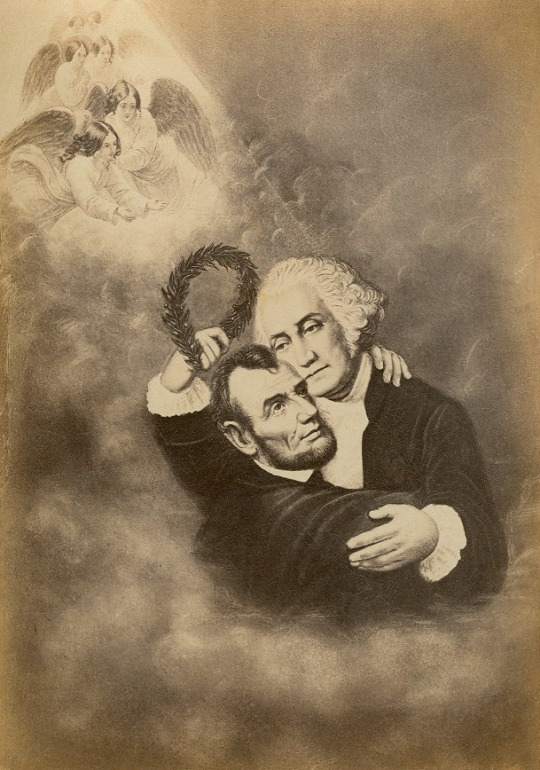
the image “george washington welcomes abraham lincoln into heaven” is so homosexual
everyones reblogging this as if its contemporary or asking who did it but i gotta inform you all it was made in the very same year lincoln was assassinated (1865) and we literally have NO GODDAMNED CLUE who made it and its like fuckin 150 years old
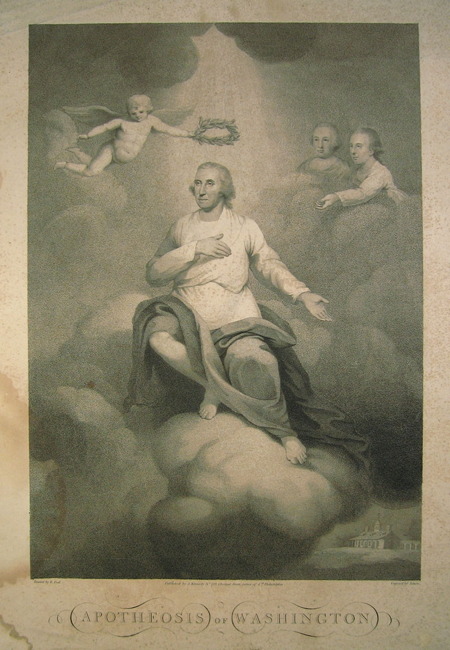
no but here’s where the story gets wild, because this was a thing. and I don’t just mean super gay-looking quasi-religious ascensions of Lincoln into Washington’s arms, we’re talking waaaay weirder than that. I don’t know why it’s not covered in American history classes, because it’s amazing, but Washington enthroned in heaven was such a common motif in American art (largely immediately after his death and again after Lincoln’s assassination) that it has a name: the Apotheosis of Washington. said motif is, simultaneously, incredibly American, incredibly French, incredibly lame, and actually kind of moving in terms of early national mythmaking.
the imagery is largely lifted from paintings of the assumption of the Holy Virgin (as seen here, courtesy of Titian), and usually has Washington ascended into heaven, surrounded by embodied virtues, cherubs, or best of all, old army buddies
(both of whom I briefly mistook for Marie Antoinette)
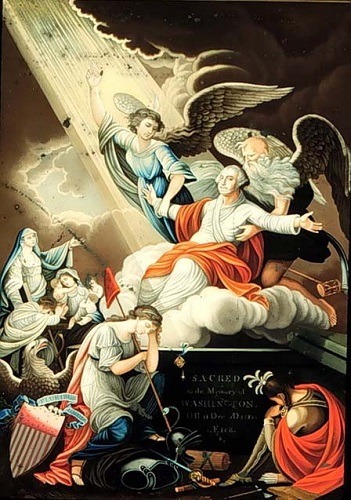
or here’s a good one, Washington being lifted from his crypt by Father Time and an angel, wearing the expression of a man doing the world’s most unenthusiastic trust fall. note Lady Liberty weeping at his feet, and the Native American warrior playing the part of the grieving land itself. there’s a strong Napoleon vibe in this one, which probably isn’t an accident. that was a man who knew a little something about artistic self-deification.
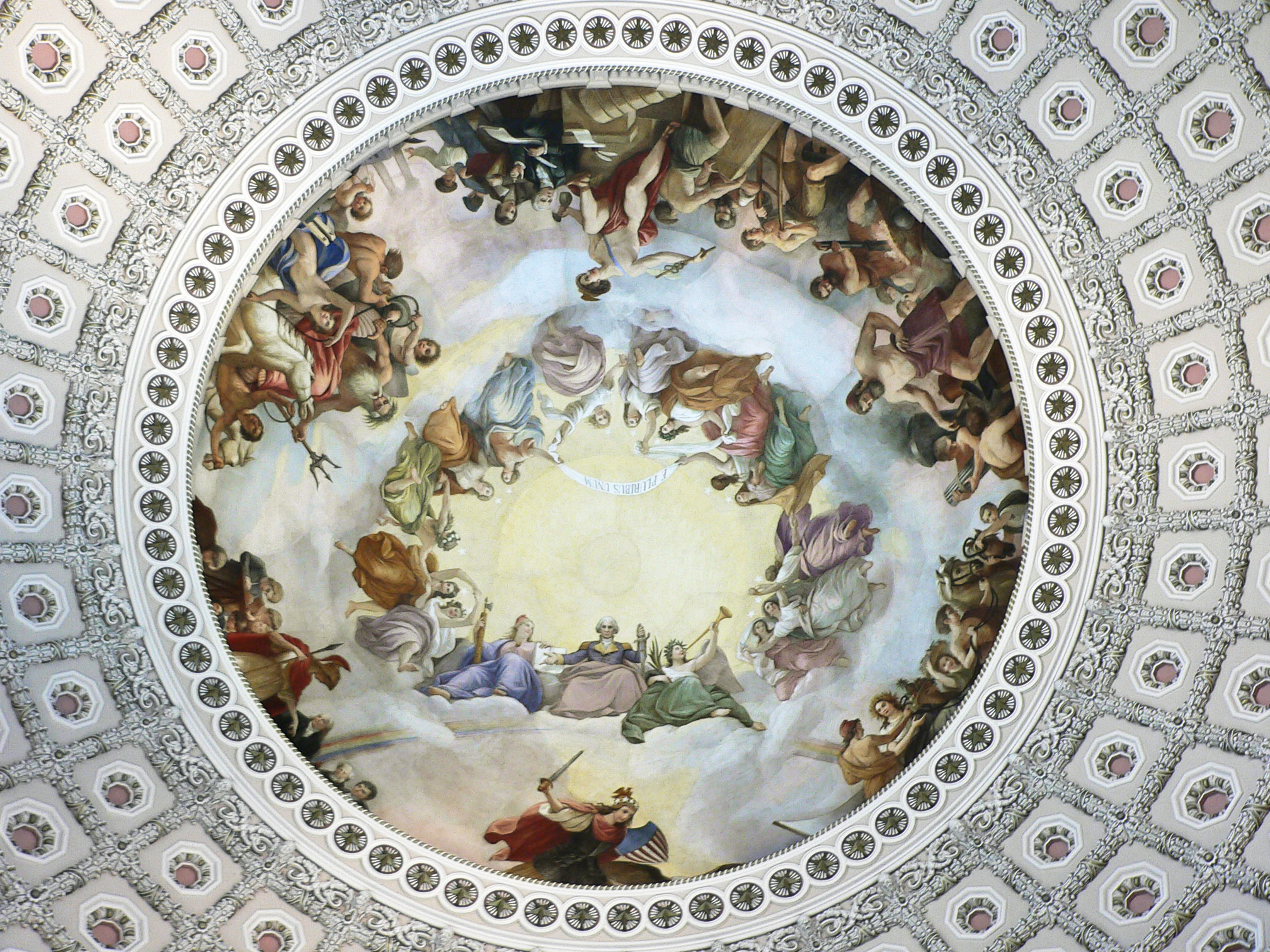
but the prime example of this motif is in the United States Capitol, in a fresco of the same name, (too detailed to blow up here) where Washington sits enthroned, outfitted in military finery and flanked by Liberty and Victory. around him are six scenes displaying American virtues, or rather–with all due disrespect to Neil Gaiman–American gods: Freedom (depicted, tellingly, as War), Science, the riches and firepower of the Sea, Commerce, Mechanics, and Agriculture. Washington presides over all of them, as the man who created a nation with the strength of his will and the fire in his heart. the heavens are spread around him, and he gazes down at the American experiment sternly and benevolently.
…in other words, monarchy is a really hard habit to kick, especially in art. but the Apotheosis of Washington comes at a real crossroads in the developing American psyche. yeah, there’s a lingering hunger for kingship, that old tendency to bend at the knees, ringed around–visually overpowered–by what would rise to fill that void: commerce, invention, war, and the uniquely American conception of Liberty.
the Lincoln thing is water from the same source: Washington forged the country, Lincoln preserved it, and paid the greatest price for his efforts. in fact, the Capitol painting was commissioned the same year Lincoln was shot, for obvious reasons. the almost-but-not-quite-kissing image of both men in the original post was actually a postcard, and was distributed in large quantities in the months following Lincoln’s death. I like to imagine that people had them pinned up in their houses, where they could unconsciously admit another president into the pantheon of gods
but please never be sorry i found your old art history movements LJ post years ago, got a museum studies degree (best known by my family as “don’t ask what her art history classes are like, she’s going to tell you she’s studying butts in England this week.”) and am now in grad school for art history and frankly weird facts about art like this is my literal favorite
please enjoy these other hilariously great pseudo god-like Lincoln’s and/or Washington’s that are my favorites:
a personal fave where George Washington literally stands in for God with a halo of sun rays emanating from his face under which angels call up Lincoln to heaven done by Philadelphia’s Max Rosenthal and also apparently people argue about whether or not it was said “Now he [Lincoln] belongs to the ages.” or “Now he belongs to the angels.”
If you study history for a living you get used to being less than certain about many important facts. Take the famous comment attributed to Secretary of War Edwin Stanton as he stood weeping beside Abraham Lincoln’s deathbed on the rainy Saturday morning of April 15, 1865. “Now he belongs to the ages,” Stanton is supposed to have said, soon after his friend stopped breathing.
also this Pemberton print for Washington where a woman in blue weeps over his death in front of a giant obelisk in a completely unsubtle cribbing of the Virgin mourning christ









 A Middleground