
Author: marcythewerewolf
Under D&D rules, a dagger does 1d4 base damage. The average human has a Strength score of 10, adding no bonuses. Several of them, due to the military background of many, likely had strength or dexterity scores of 11-14. But only two or three, and quite a few would be frail with old age, sinking to 8-9 strength. All in all, we can only add a total of +1 damage per round from Brutus.
An estimate of sixty men were involved in Caesar’s actual murder. Not the wider conspiracy, but the stabbing.
Julius Caesar was a general, which is generally depicted as a 10th level fighter. Considering his above baseline constitution and dex, weakened by his probable history of malaria, epilepsy, and/or strokes (-1 dex modifier), and lack of armor at the time of the event, he would likely have something along the lines of AC 9 and 60 HP. The senators would likely hit him roughly 55% the time.
So the Roman senate had a damage-per-round of 66, more than enough to kill Caesar in one round even without factoring in surprise round advantage.
Now THESE are the kind of statistics I wanna see!
do the hogwarts cafeteria tables have a restriction on who’s allowed to get coffee? i want to believe there’s safety measures in place to make sure ravenclaws don’t get a six cups a day habit before they hit puberty but this is a school that encourages its students to play high-speed flying murderball so
…that begs other really interesting, equally important questions, such as: what about dietary restrictions? What about food allergies? Do the house elves make sure that no kid gets exposed to something that’d kill them? Are all the sausages at a table with a kid who’s Jewish or Muslim made of beef (or lamb) instead of containing pork? Are there elves watching the tables, doing rapid-fire food substitutions to make sure none of the kids eats something that’ll make them sick or violate their cultural mores?
And what about the kids who need coffee, because they haven’t figured out yet that certain potions are a better substitute for what the caffeine does to help slow their mind down and give them back the ability to focus?
I need a fic on this now, and I’m pretty sure there are none, this is terrible
there’s a trend on tumblr to imagine all the personal accommodations the wizarding world might make for students, but hogwarts is a terrible place. it’s fucking terrible. i don’t know why so many people have forgotten this crucial element of the series.
like. the house elves are slaves, the potions teacher has free reign to traumatize preteens and was an active member of a terrorist organization in his youth, students receive tons of injuries from murderball as well as all the other crazy shit they’re allowed to do to each other, like there’s a dueling association!!, dumbledore locks an unmarked door with a gigantic man-eating dog with a spell an eleven year old can cast. because he invited magic hitler to teach self defense for a year. the stairs randomly change directions and there’s no ramps. a man with no teaching experience whatsoever got to procure a whole bunch of deadly monsters and force 13 year olds to pet them. and the ghost of a kid who was murdered by teenage magic hitler is trapped in a girl’s bathroom to cry forever because of this school’s almost entirely unresolved history of minority discrimination.
i think if anthony goldstein, the one single jewish kid unfortunate enough to go to wizard hell school, wanted to keep kosher he would have had to do it himself. i think if you need special accommodation at hogwarts you can just basically go fuck yourself. i think if you want anyone to respect your cultural traditions at hogwarts you can probably double go fuck yourself. hogwarts is a place where generations of witches and wizards have lived and learned and grown up. it’s also a place where a whole lot of kids have died.




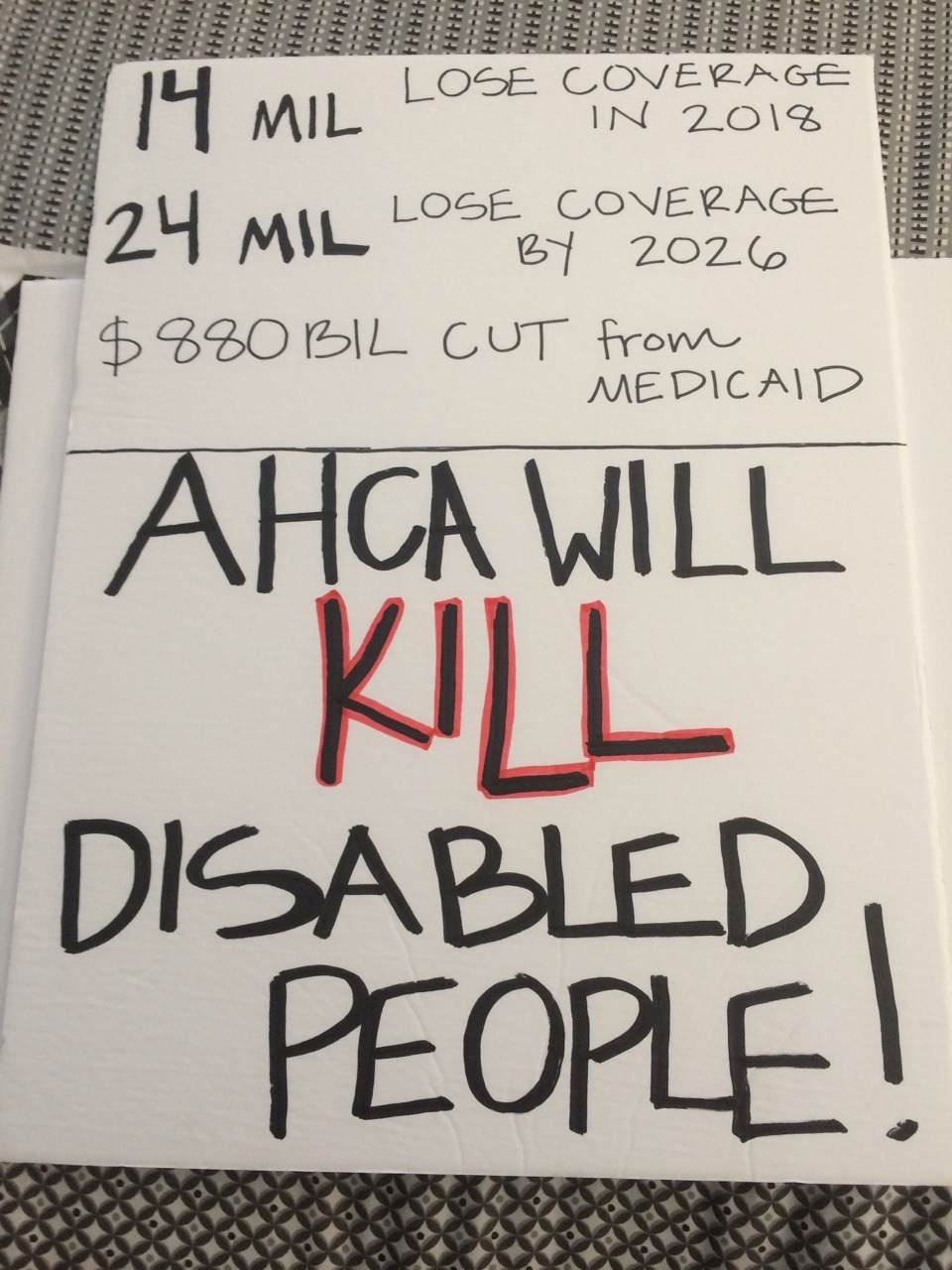
I attended a local event today, and spoke with staffers for senators Hatch and Lee about concerns over:
1. implementing Medicaid per-capita caps that will slash funding for disabled and low-income people to the tune of at least 880 billion dollars
2. switching to a continuous coverage policy that will punish sick people who are more likely than healthy peers to go 63 days without insurance, while simultaneously being desperate enough need healthcare to pay the 30% fee
3. cutting the essential health benefits requirement, which covers 1.3 million Americans with mental health disabilities who will be left without necessary care
these proposed measures, among many others, will cause out-of-pocket costs to soar and cause 24 million people to lose coverage by 2026–14 million of those NEXT YEAR.
these drastic financial cuts, and the massive number of Americans losing insurance will have unpredictable and dangerous consequences.
40% of people in the US have at least one chronic illness. 20% are disabled.
so it stands to reason that at least 40% of those losing access to medical and psychiatric care will have health needs. they will be sick.this is going to kill people.
yet, the senate staffers were mostly silent. they repeated the line “we look forward to a robust debate on the floor” a few times…
they told us that they know illness doesn’t discriminate between political party, and I reminded them that it doesn’t discriminate between tax bracket either.
I mentioned that a 64-year-old earning $26,000 per year is just as likely to get sick as a millionaire, yet she’s now paying half her income in premiums under the AHCA, while the millionaire is going to see that $13,000 in a tax cut.
they changed the subject.







glistening stars & silence
Sometimes I head up into the local mountains to take photos. It’s nice to get away and get lost looking at the stars. The mountains and darkness eminate a foreign adventure. It’s so dark that it takes a few minutes for your eyes to adjust, but once they do it’s almost as if you’ve become part of some unwritten fairytale.
All these shots are between thirty and fifty second exposures. The time varies depending on the moonlight and starlight. I try to make the exposures connect together as if they’re forming a single mountain.
multiple exposures shot on medium format film.
My brother works for Sesame Street with their touring shows. The day after the election, the company he works for decided they would not be able to keep the tours going because they were going to lose a significant amount of funding due to Trump’s presidency.
It’s happening now. Disney bought out all of the venues they usually go to and they couldn’t compete with the cost so he and his fiancee aren’t going to have jobs after they get married. This is officially the last set of tours by Sesame Street, indefinitely.
He and his fiancee don’t really know what they are going to do. They think they might move to Atlanta but, honestly, they’re going to have to go where they can find work. That’s part of being a freelancer and one of the reasons I had to get out of theatre (constantly being on the lookout for a job is mentally taxing).
It sucks that they’ll be starting their marriage like this.
The reason I posted this is because a while ago there was a lot of upset about Sesame Street airing shows on HBO a week earlier for kids whose family can afford HBO. And people were so disappointed with Sesame Street for agreeing to that.
But, like, honestly, Sesame Street is struggling and has been for a while. Their agreement deal with HBO was a good thing. Sesame Street’s funding is dying and I will be really shocked if it survives the next four years or remains publicly available. The people in power don’t want Sesame Street to exist. It teaches kids empathy and kindness and thoughtfulness. It exposes kids to diversity and teaches them openness and caring about others, which is exactly what fascists DON’T want. It’s exactly what CONSERVATIVES don’t want.
Sesame Street is dying and it will be a goddamn miracle if lasts through the next four years.
In case anyone is curious, PBS has always taken donations. The federal government has always shortchanged them horrifically, and various shows have had to be saved in the past. Here’s a lineup of press releases from them that display the diversity of their underfunded original programming (because it’s basically all underfunded). There have been threats to Sesame Street before; we can overcome this. Part of that is making sure local partner stations remain in the black.
However, the financial situation may not be as dire as it looks from this one example. Yes, some parts of the franchise, like the tours, may close. Financial statements for Sesame Workshop indicate it will probably continue to operate, even with more limited government funding, because it gets a minority of its funding from the government now. However, it may indeed have to cut more jobs and some aspects of programming; there’s no guarantee that won’t happen even if it gets a larger portion of its funding from its parent non-profit. Here’s an article from Slate about the PBS financial situation in 2012, with historical accounts of previous tough times. Here’s the New York Times take on the same issue, with the key note that loss in state funding for local stations is a large (and largely ignored) issue.
Financial statements for 2016 for PBS are not yet available, but several previous years’ financial statements are. It would take an accountant to read those statements properly, but the for-profit subsidiaries of PBS were paying 200+K and 300+K in corporate taxes respectively. That indicates they were probably turning a small profit in those years. However, I’m not sure such profits could cover Sesame Workshop’s potential losses.
Want to make a difference? Make a donation to your local PBS station or send a postcard to your Reps/Senators in Washington telling them you want funding for PBS left untouched. Or both! Both is good.
BOOST THE FUCK OUT OF THIS
This is so fucking amazing!
Some solutions may seem so small but this is a greater impact.
BOOST THE FUCK OUT OF THIS GUYS
‘No Such Thing as Absolute Privacy in America,’ Warns FBI Director Comey
“There is no such thing as absolute privacy in America,” Comey announced at the conference, Politico reported. “There is no place in America outside of judicial reach.”
This comes on the heels of a Wikileaks dump that revealed the CIA is working on hacks into everything from smart televisions to cars. The reality of a mass surveillance state has been apparent at least since then–National Security Agency contractor Edward Snowden leaked information in 2013 that the organization was spying on the public, so admissions like these from the intelligence community should come as no surprise. Yet the candidness with which Comey admits that Americans’ privacy is circumscribed is striking.
He acknowledged that the law says “all of us have a reasonable expectation of privacy in our homes, in our cars, and in our devices,” but provided a nice little caveat that if it has a “good reason,” the state can nonetheless “invade our private spaces.”
“Even our memories aren’t private,” Comey added, according to Politico. “Any of us can be compelled to say what we saw…In appropriate circumstances, a judge can compel any of us to testify in court on those private communications.”
Back in 2015, a Pew Research poll found Americans were not nearly as concerned as you might think about the government spying on them. Some 54 percent were not very or not at all concerned about officials snooping on their emails; 53 percent felt the same way about their search engine data. Even when it came to cellphones, 54 percent were not concerned.
Many participants explained that they were not worried about government surveillance programs as long as they were helpful in preventing terrorist attacks or criminal activity. It appears, in this instance anyway, that a substantial segment of the population prefers security to liberty.
‘No Such Thing as Absolute Privacy in America,’ Warns FBI Director Comey
 A Middleground