Is it possible to walk through the gates of hell and live? The Romans thought so, and they staged elaborate sacrifices at what they believed were entrances to the underworld scattered across the ancient Mediterranean. The sacrifices—healthy bulls led down to the gates of hell—died quickly without human intervention, but the castrated priests who accompanied them returned unharmed. Now, a new study of one ancient site suggests that these “miracles” may have a simple geological explanation.
Rediscovered just 7 years ago, the gate to hell at the ancient city of Hierapolis, in modern-day Turkey, is a stone doorway leading to a small cave-like grotto. The gate was built into one wall of a rectangular, open-aired arena, topped by a temple and surrounded by raised stone seating for visitors. The city itself sits in one of the region’s most geologically active areas; 2200 years ago, its thermal springs were believed to have great healing powers. Read more.
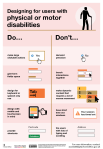
The dos and don’ts of designing for accessibility are general guidelines, best design practices for making services accessible in government. Currently, there are six different posters in the series that cater to users from these areas: low vision, D/deaf and hard of hearing, dyslexia, motor disabilities, users on the autistic spectrum and users of screen readers.
[…] Another aim of the posters is that they’re meant to be general guidance as opposed to being overly prescriptive. Using bright contrast was advised for some (such as those with low vision) although some users on the autistic spectrum would prefer differently. Where advice seems contradictory, it’s always worth testing your designs with users to find the right balance, making compromises that best suit the users’ needs.
I saw a post a few nights ago that basically flat-out said that historians (just a vague sweep of the entire field) were actively working to wipe away LGBT+ people from history and to come up with sad, sorry excuses as to why X, Y, Z person couldn’t possibly be LGBT+.
See, I’m the first to criticise some of the more old-school historians who often have loud voices in the field, for their stubborn nature and unwillingness to evolve with the study of history. They might not “actively” be working to keep LGBT+ history as on the down-low as possible (I don’t believe there’s really an agenda here, just ignorance and a touch of the archaic within academia) but they contribute to the pervasive and harmful ideas about the place of LGBT+ people in history. I don’t deny that and I’ve made many a post on it, had many a spar, particularly in regards to bisexuality in history. It’s something I’ll probably come across in my professional life.
But I take great offence to such a sweeping generalisation just because I know how much it isn’t true. I’m a bisexual history graduate. A lot of people on my degree course were LGBT+ and as such, took an active interest in their own history. A lot of people who run stellar history orientated blogs on here are LGBT+. There is no grand conspiracy within the field of history, especially now that the younger generation of historians are pushing through with new perspectives. I can list off a whole plethora of books that have been released in recent years that deal directly with LGBT+ presence in 17th and 18th century European spaces. Historic Royal Palaces (the organisation that takes care of Britain’s main old palace complexes) has started to hold Palace Pride every year for LGBT+ Pride Month. Some of you know I went to one of these Palace Pride events at the Banqueting House of Whitehall Palace a few months ago where LGBT+ identities of the court of King James I were celebrated, as well as other aspects of LGBT+ history of the 17th century (gender roles particularly: there was a “queerlesque” show at the event to reflect this.) There’s a serious push against old habits in the field of history right now. I even took a course in my second year at uni on sexuality and gender circa. 1660-1815 and it was popular with a whole host of different kinds of students/budding historians and the sources available came at me in their droves. Put simply: we. are. doing. the. work.
Frankly, it’s just annoying to see such blatantly wrong negativity aimed at historians and it’s very….idk….“We’re sick of experts”-esque? Like, it’s a little anti-intellectual. It’s obvious that the people levelling these kind of accusations at historians don’t know anything about it, or refuse to put in the work to FIND OUT anything about it. It’s also a slap in the face to all the hardwork I and so many others do. In fact, it’s a double slap in the face to me, as both a young historian and a bisexual woman. It’s important that we have these conversations, these discussions about people’s identities and experiences in the past with as much attention to nuance as possible (whilst also simultaneously not erasing the simple truth that LGBT+ people have always existed) but negative shit like this makes it so much harder.
In this day and age, it can be profitable to scare people away from actual historians by asserting that they’re all part of the straight/white/cis/male hegemony and work to uphold the kyriarchy instead of tearing it down – “don’t trust them, trust me.” There’s enough of a grain of truth to it (if you pick up an older history book, it’s going to be extremely conservative by modern standards) that it works, and current academic output is often beyond a lot of people’s immediate reach. But there are ways to get around that and certainly a number of great public history outlets.
Obligatory plug for AskHistorians! We (I’m a moderator) make an effort to highlight diverse historical topics and spend hours every day moderating out the average Redditor in order to give a platform to good historic analysis, much of which is actually written by academics.
It’s easy to say that pushing people to look at “official” sources rather than trusting those who tell you to trust them without sources is gatekeeping, because, well, to a certain extent it is. It’s not like only people with higher-level degrees can find primary and secondary sources and construct arguments. But the thing I’d like to point out is that the most important things getting a degree teaches you are:
1) How to evaluate sources. In large part this is because you’ll see so many on similar subjects and learn enough of the underlying history that the subtext will start to pop out. This article claimed that X never happened, but you know it did – why would they say that? This book cites Y three times and never Z when Z is more up-to-date – is the writer up on their stuff?
2) Possibly even more important, how to take criticism and how to criticize yourself. How to block off the instinctive “HOW DARE” reaction when someone says you’re wrong and consider their actual point divorced from whether or not they were polite when they made it.
I’ve learned a lot more about fashion/textile history since leaving grad school than I did while I was there; I’ve even learned that some of the stuff I was taught was wrong. You definitely don’t have to be enrolled in classes to learn. But trained, active historians know things, and you should be wary of someone who paints them with a broad brush and no reference to actual works or statements.
Speaking as a bi person in a historical field… historians, with their tendency to put nuance into things, to acknowledge that the world has not always operated on a gay/straight binary, and that gestures and social relationships and /the very definition of sex/ change meaning over time… are waaaay more likely to present a historical figure in a way that I can identify with than ‘GAY GAY THEY’RE ALL GAY’ Tumblr ever does.
Facebook is not a privacy company; it’s Big Brother on PCP. It does not want to anonymise and protect you; it wants to drain you of your privacy, sucking up every bit of personal data. You should resist the urge to let it, at every turn.
There’s a new menu item in the Facebook app, first reported by TechCrunch on Monday, labeled “Protect.” Clicking it will send you to the App Store and prompt you to download a Virtual Private Network (VPN) service called Onavo. (“Protect” shows up in the iOS app. Gizmodo looked for it on an Android device and didn’t see it—though, presumably it is only a matter of time.)
Millions of people use VPNs to enhance their privacy online. But that is not Onavo’s function.
VPNs work by forcing your laptop or mobile device to establish a connection to a third-party server before then connecting you to any websites or online services. Using an encrypted tunnel, a VPN can prevent your broadband or wireless provider from keeping track of the websites you visit. What’s more, a VPN service can mask your own IP address from those websites, helping you to traverse the net without surrendering locational data. VPNs also help users in authoritarian countries bypass censors by convincing websites their country of origin is, for example, the US or Switzerland, the latter of which has some of the world’s strictest privacy laws.
Facebook, however, purchased Onavo from an Israeli firm in 2013 for an entirely different reason, as described in a Wall Street Journal report last summer. The company is actually collecting and analysing the data of Onavo users. Doing so allows Facebook to monitor the online habits of people outside their use of the Facebook app itself. For instance, this gave the company insight into Snapchat’s dwindling user base, even before the company announced a period of diminished growth last year.
To put it another way, Onavo is corporate spyware.
If you’re someone who can’t live without Facebook or simply can’t find the courage to delete it, the Onavo appears under the “Explore” list just above the “Settings” menu. I’d recommend you never click it. Facebook is already vacuuming up enough your data without you giving them permission to monitor every website you visit.
If you’d like to use a VPN service, there are literally tens of thousands to choose from. The good ones cost money—usually £3 to £9 a month. It’s important to remember, while they mask your activity from your ISP, the VPN company itself may be able to see virtually everything you do online.
For that reason alone, recommending a good VPN service can be tricky. But if you’d like one to check out, try giving Private Internet Access a look. And educate yourself: Read more about how VPNs work at the Electronic Frontier Foundation. [TechCrunch]
Skeleton, the sliding event in which athletes race down an ice track head first, is a fast-paced and punishing sport. Skeleton racers can reach speeds of 125 kph (~80 mph) during their descents. This is a little slower than the feet-first luge, in part because the skeleton sled runs on circular bars rather than sharp runners.
Body positioning is key in the sport. It’s the athlete’s primary method of steering, and it controls how much drag slows them down. But skeleton runs are brutally taxing; athletes pull 4 or 5g in the turns – more than astronauts experience during a launch! All that jostling means athletes cannot stand more than about 3 trips down the track in a day. To practice positioning without the bone-jarring descent, athletes can work in a wind tunnel. While the wind tunnel provides the aerodynamic equivalent of their usual speed, athletes focus on holding their bodies in the most streamlined position. Some wind tunnels are even able to provide screens that let the athletes see their drag values in real-time, letting them adjust to learn what works best for them. (Image credit: N. Pisarenko/AP, Bromley Sports)
Several years ago, the Bodleian Library mounted an exhibition called Playing with History.
It featured one game enthusiast’s historical collection of games and
pastimes with an eye toward how games have been used through the ages to
address the issues, challenges, and ideals of the time. One of the more
fascinating games in the collection is Suffragetto, a board game from sometime around 1908/9 (the release date is debated).
Suffragetto was created by members of the militant British
suffragette group known as the Women’s Social and Political Union
(WSPU). A piece on Suffrajitsu explains gameplay:
Players enact the roles of either the
suffragettes, represented by 21 green markers, or police constables,
represented by 21 dark blue markers. The suffragettes’ object is to
occupy the House of Commons with six markers while defending their home
base of the Albert Hall against the police, whose object is, likewise,
to occupy Albert Hall while defending the House of Commons.
Apparently, the Bodleian Library copy of the over 100-year-old game
is the only one known to exist. But, thanks to Suffrajitsu, you can play
an online version, and thanks to GA Tech, you can also download and print the game, including the box art. Bone up, kids. We might be playing this on the streets again in the near future.
In the current political climate, the assault on Americans with disabilities is no longer limited to attempts to strip them of health care, take away the services millions need to live independently and to work, or make deep cuts to programs that help many make ends meet. Now a bill making its way through Congress threatens to roll back the civil rights of people with disabilities by exactly 27 years. The bill, misleadingly titled the ADA Education and Reform Act of 2017, would hack away at the Americans with Disabilities Act (ADA) of 1990, the landmark civil rights law that prohibits discrimination on the basis of disability and mandates that people with disabilities have “equal opportunity” to participate in American life.
The bill would roll back disability rights and inclusion
Prior to the Americans with Disabilities Act, it was far more arduous for Americans with disabilities to participate in mainstream society. Public places such as hospitals and restaurants were often inaccessible to people with disabilities, and these individuals had no recourse against the owners of these establishments who, in effect, barred them from entry. After the passage of the ADA, places of public accommodation—that is, privately owned, leased, or operated facilities—were required to take proactive steps to be reasonably accessible to people with disabilities.
Although the ADA has enabled people with disabilities to participate far more fully in public life, some businesses remain inaccessible because of architectural obstacles, such as inaccessible entrances, bathrooms too small to accommodate someone in a wheelchair, and lack of curb cuts, to name just a few. Fortunately, under Title III of the ADA, people with disabilities have the right to file lawsuits against proprietors of businesses that lack reasonable accommodations. Indeed, despite businesses’ obligation to take proactive steps towards accessibility, litigation has been the mechanism through which many gains for people with disabilities have been achieved since 1990. But the ADA Education and Reform Act, which has been met with deep opposition from the disability community, would fundamentally weaken this process in ways that would make it prohibitively burdensome for many people with disabilities to enforce their long-standing civil rights.
What the bill would do
The ADA Education and Reform Act would create onerous red tape for people with disabilities attempting to enforce their rights under the ADA. Specifically, the bill requires anyone seeking to file a lawsuit under Title III to first provide written notice to the business owners in violation of the law, citing very specific details regarding the provisions of the statute that apply to their particular case. Business owners would then have 60 days to acknowledge the violation and another 120 days to at least make “substantial progress” towards rectifying it. This means that under the bill, places of public accommodation—which have had nearly three decades to comply with the ADA—would have yet another six months just to begin to rectify their violations of the law. As the American Civil Liberties Union points out, under this bill, “Business owners can spend years out of compliance and face no penalty even after they receive notice, so long as the owners claim ‘substantial progress.’” People with disabilities, in turn, would have to wait at least that long to access justice.
The bill is based on exaggerated claims
This latest attempt to curtail the civil rights of people with disabilities was reignited by a popular “60 Minutes” segment alleging the widespread filing of frivolous Title III lawsuits by attorneys who spot ADA violations using, for example, Google Earth. The segment implies that people with disabilities have no complaints about the noncompliant establishments but that, because of these lawsuits, business owners end up with a bill that many of them cannot afford to foot. It’s important to note that under Title III, those in violation of the ADA do not have to pay any monetary damages, only attorney’s fees and injunctive relief, meaning business owners must remedy the violation.
So-called frivolous lawsuits, however, are nowhere near as pervasive as proponents of the ADA Education and Reform Act suggest. Proponents of the bill point to increases over the past several years in Title III filings, including a 37 percent uptick in 2016 compared with 2015. But a quick look at the numbers shows that this increase is easily explained by a small number of large-scale filers. In fact, just 12 individual attorneys and a single disability law firm were responsible for more than one-third of all Title III lawsuits filed in 2016, accounting for more than 100 cases each.
Even in the unlikely event that all of these large-scale filers’ lawsuits were indeed frivolous—which is disproven by the fact that many of them have brought to light very real violations of the ADA—they would hardly present an issue systemic enough to warrant federal intervention, particularly when such an intervention would gut a decades-old civil rights law. Additionally, protections against the filing of frivolous lawsuits are enshrined in existing ethics rules. As disability rights lawyer Robyn Powell notes, frivolous lawsuits can already be addressed through district courts, as well as by state bar associations.
What proponents of the ADA Education and Reform Act also seem to ignore is that Title III of the ADA was, in many respects, the product of a compromisebetween the disability community and business interests. As a result, businesses are only required to provide accommodations when doing so doesn’t present an “undue burden” and when they are “readily achievable”—that is, technically feasible and affordable. What’s more, there have long been in place federally funded resources to help businesses comply with the law, including ten regional centers that provide technical assistance and trainings in every state. And again, under the ADA, plaintiffs are unable to obtain monetary damages from businesses. Any settlements or court orders involving monetary damages are based on state laws, not the ADA.
Conclusion
Places of public accommodation have had a full 27 years to comply with Title III of the ADA. Yet, despite substantial gains since 1990 when the ADA was signed into law, American society is still rife with architectural barriers that prevent people with disabilities from fully participating in public life. The ADA Education and Reform Act all but condones the businesses that, nearly three decades after the ADA was enacted, have yet to comply. As the Consortium for Citizens with Disabilities has noted, there exists “no other law that outlaws discrimination but permits entities to discriminate with impunity” until after victims of that discrimination inform business owners that they’re breaking the law.
There are plenty of places that still don’t meet the requirements of the current law and as such, disabled people are barred from having equal access to the same facilities that able-bodied people have. Any bill that would push ADA requirements back is a form of legalized segregation.













 A Middleground