


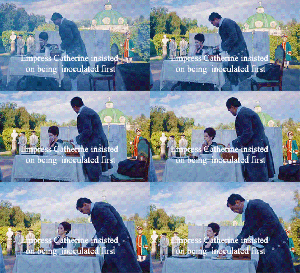

In XVIII century smallpox was a dangerous matter. In Europe several reigning monarchs were sent to the grave by smallpox. In Russia one of the victims was Peter I the Great’s grandson, 15-year-old Emperor Peter II who died of smallpox on his wedding day. Another victim was the future Emperor Peter III, the husband of future Catherine II the Great. He suffered from a rather severe case of smallpox that left him with ugly scars and very little hair. In 1767 a smallpox epidemic in Siberia wiped out some 20,000 people.
Fear for herself, her son Paul, and the nation prompted Empress Catherine the Great to investigate a new, controversial method of inoculation that assured permanent immunity: the injection of matter taken from the smallpox pustules of a patient recovering from a mild case. This medical technique was shunned in continental Europe as being too dangerous. Catherine invited the greatest expert of the day, Dr. Thomas Dimsdale of England to perform inoculation on herself, her son and her court. She wanted to set a personal example to the people of Russia and demonstrate them that the procedure was safe.
On 12 October 1768, Catherine was inoculated in both arms with smallpox matter taken from a peasant boy named Alexander Markov, whom she subsequently ennobled. She developed a mild case of smallpox that was gone by the 28 October. After that young Paul was inoculated and Catherine’s example was followed by nobility. A Russian translation of Dimsdale’s treatise explaining his technique was published in St. Petersburg, and inoculation clinics were established in St. Petersburg, Moscow, Kazan, Irkutsk, and other cities. By 1780, twenty thousand Russians had been inoculated; by 1800, two million. As a reward for his service, Catherine made Dimsdale a baron of the Russian Empire and awarded him ten thousand pounds plus a life annuity of five hundred pounds. In 1781, Dimsdale returned to Russia to inoculate Catherine’s first grandson, Alexander (future Emperor Alexander I).
Source: Catherine the Great: Portrait of a Woman by Robert K. Massie
@ourgraciousqueen

 A Middleground